
Create a beautiful swimming pond in your own backyard without the need for any chlorine!
Natural swimming ponds
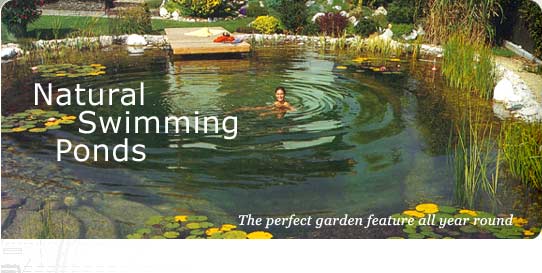 Natural swimming ponds do not use the complicated technology of chemical sterilization and filtration. Instead, they use nature's infinitely more sophisticated technology: ecological balance. As in a natural lake, micro-organisms break down organic matter into materials which plants can use as nutrients.
The use of natural processes in artificial swimming pools was pioneered in Austria (c 1985) by Peter Petrich and a company called Biotop. Since then, the principle has been widely used in continental European homes, hotels and resorts. The swimming pools are ecologically balanced, self cleaning and beautiful. Instead of worrying about whether chlorine is damaging their eyes and mucus membranes (possibly aggravating asthma and nasal congestion), swimmers can feel confident in doing what their ancestors have done since prehistoric times: swimming in fresh clean water.
Design principles for natural swimming ponds
- Pool Area - natural ponds are larger than chemically treated pools (eg swimming area of 25 sq metres and a biological area of 25 sq metres). One or two walls of the pool will rise above the water surface to allow access for swimmers. The other walls (between the swimming and planted areas) will be 100mm below the water surface.
- Swimming Zone - a deep swimming area (1.5 to 2.5m). This zone can be walled and tiled (and cleaned with a normal pool bottom cleaner).
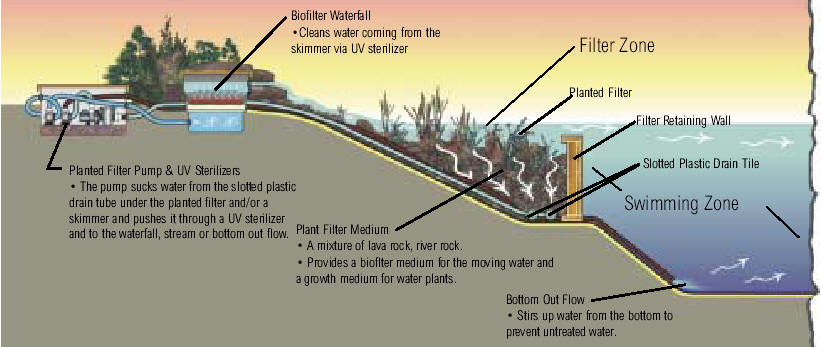
- Regeneration Zone - a marginal area planted with aquatic and semi-aquatic plants. This area needs to be at least as large as the swimming zone. The aquatic plants grow in shingle (without topsoil) so that they are forced to take their nutrients from the water. Pruning and removing plants (usually in winter) takes nutrients out of the pond.
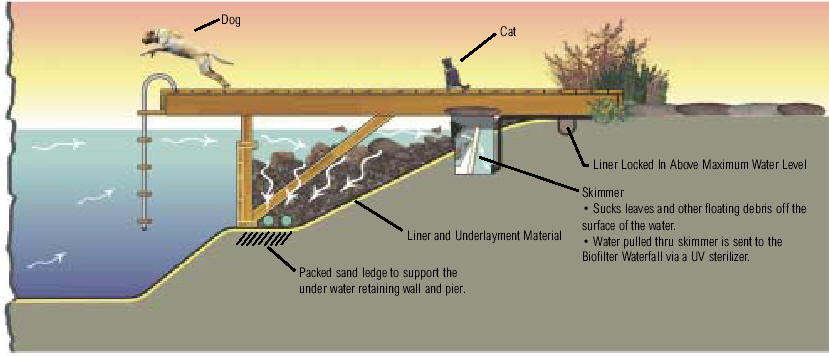
- Pump Chamber - the pump (1) draws water through the Regeneration Zone (2) draws water from the surface of the pool, to remove floating debris (3) returns the water to the Swimming Zone, after filtration.
- Heating - if the pool is heated the plants will grow faster than normal and will have to be thinned from time to time.
- Drainage Ditch - the pond is surrounded with ditch to keep out surface water runoff (which would introduce nutrients and affect the ph of the water)
Cost note: costs tend to be higher for natural swimming pools than for conventional swimming pools
Let’s Go Swimming
Have you ever seen how many pounds of chemicals go into a typical swimming pool? Have you ever read the warning labels on the chemicals used to sterilize typical swimming pools? The basic philosophy behind water quality in a typical swimming pool is to kill everything short of killing the swimmer. There is another way.Visualize this: you are lazily floating, toes up, in a pond of sparkling clear running water, surrounded by wild grasses. Hummingbirds land on nearby trumpet flowers and the scent of jasmine and mint is in the air. Is this a dream or some mid-life fantasy? Neither. You may just be part of a new trend in swimming the natural way -without chlorine or other harsh chemicals in the water.
In a natural swimming pool we harness natures’ own processes to produce clean, clear water. If you have ever had the opportunity to swim in a crystal clear lake or stream, then you know the sense of bliss that only nature can supply. Swimming is much more enjoyable without burning eyes and chemical odour.
In Europe they have built hundreds of natural swimming pools since 1985. Interviews with pool owners have shown overwhelming satisfaction.
We have tested and swam in pools by Bio Nova and BioTop (see photo of Mick in Germany). Their systems' work well when water temperatures are cold (colder than 25 degrees centigrade). We have developed a system for much warmer climates. From Canada to Mexico, our system is biologically safe and will pass the bathing water standards in your area.
What about mosquitoes?
Natural predators and moving water make a Natural Swimming Pool practically mosquito free. Four tires stacked in your neighbour's backyard will create 100 times more mosquitoes.
What do we clean from the Water?
- Ecoli and other harmful bacteria
- Plankton algae
- Oils, including skin oils
- Body fluids (all kinds, including accidentals)
- Fish and fish food waste (if needed
Ponds cost roughly 20 % of what a pool would cost!
Planning an aquatic habitat is basically a three step process:
- Where are you now?
- Where do you want to go?
- How much effort do you wish to invest?
WHERE ARE YOU NOW?
This is the foundation of your success. Aquatic systems can be very complex; thus, overlooking important details can come back to haunt you in the future. We often describe this process as looking for the poison needle in the haystack. The "poison" may not kill your habitat, but it can cause chronic "illness". Many owners of lakes and streams are not even aware they have problems until they see a professionally designed habitat. Continual application of chemicals and mechanical treatment of your lake or stream are symptoms of this design deficiency syndrome. Once you see a professionally designed habitat with larger, healthier fish, fewer weeds, clearer water and enhanced aesthetics, you will realize just what you have been missing or could have.
A clear understanding of what your resources are to begin with will build a solid foundation for the best possible design. Please consider the following list of topics when contemplating your lake or stream project. You may not have all of the exact answers to start with, but do the best you can, then you will be able to write us and convey your situation much more clearly.
NOTE: If your site does not have an existing pond, collect information from a nearby pond. This will tell us the natural tendencies of your site. Click here for a printable version of this page so you can answer as many of these questions as possible when you talk to us.
...The Questions...
- Do you have a photo/video of your lake, stream or site? This is very valuable in the process. A set of photos taken each season or change of water appearance is best.
- Where is your lake located? At what elevation?
- What sort of bottom does your lake have, i.e.: mud, sand, rock? Tell us roughly what proportion of each type of substrate. If mud is present, what colour is it? Does the mud have an odour? How deep is the mud?
- Is the land flat around the lake, or sloped? How steep? What aspect does it face?
- What do you have for a water source, i.e.: springs, creek, rain, wells etc.?
- If it is a spring or creek, what temperature and volume does it produce in summer and winter? (You can use relative terms; we can interpret.) Is the water supply cold, cool, or warm? Would it fill a garden hose, 2" pipe, 12" culvert etc.?
- Does a stream flow directly into your lake, or is water diverted from a stream?
- Do you have an idea of the water temperature of the pond in summer at the surface and in the deeper areas? Even general descriptions are helpful here, such as: "It's warm enough to swim in." "It gets as warm as a bath tub." "It's a bit cool for swimming" etc. How thick is the ice in winter? Does the snow get deep?
- Can you describe the general shape of the pond, including the lay of the bottom of the pond? Is a small portion deep, or is most of it deep?
- What direction do the prevailing winds come from in summer and winter?
- Are there any aquatic plant species present? If so, can you send photos of the aquatic plants. How much of the pond bottom is covered in vegetation?
- Roughly how old is the lake?
- Can you tell us a bit about the history of any fish in your lake: species, sizes etc.?
- Add any other comments you might think relevant.
WHERE DO YOU WANT TO GO?
Now we get to the section that is more fun for land owners. You get to tell us what YOU want! The description you developed above will give us the parameters we need to consider to produce your dream lake or stream. They tell us what can be possible.
In this phase, don't let your goals be limited by preconceived notions of what you think your habitat can produce. Let the fish and our experience show you what is possible. With the correct habitat design and the right type of fish, you will be astounded at the possibilities. As mentioned earlier, we have a wealth of knowledge in stretching the limits of suitable habitats for cold water trout and salmon. So many people let their notions limit what they can have. Dream a little about what you want and we can do the rest. Just because your lake gets warm at times does not mean you have to settle for warmwater game fish. We blend science with practical experience to develop creative solutions for challenges in marginal habitats.
Here are a few of the standard goals we have helped people attain. Remember there are always trade offs. Prioritizing your goals will give you the best results.
- I want trophy size fish
- I want the kids to have a clean place to swim
- I want to heat/cool my home while warming the water in my swimming pond
- I want a clear swimming pond and beach that's much cheaper than a pool
- I want to avoid potentially hazardous chemicals and expensive additives
- I want my pond to be completely natural
- I want clear water
- I want a small pond in my yard, that is very easy to maintain
- I want my pond to look like it was torn from the pages of a fly-fishing calendar
- I want a lake with large areas free of aquatic plants
- I don't want to worry about maintaining an aquatic habitat
- I want to water livestock or irrigate from my lake
- I want to pasture the banks of my stream
- I want bigger fish in my stream
- I want to be able to use my lake for fire suppression in emergencies
- I want to be able to land my float plane on my lake
- I want my property value to rise significantly
- I want to buy land, build a lake or pond and make a profit when I sell
- I want to build a private refuge for a sensitive species or strain of fish
HOW MUCH EFFORT DO YOU WISH TO INVEST?
This is where you decide exactly what you want. From an analysis of all of the information you have provided, we can give you an idea of what we offer at various levels of assistance in your project. We can almost always provide immediate results with only a few hours of energy invested in your project. With a bit more time, we can provide solutions that only a professional, who has dedicated a lifetime to studying aquatic systems, can develop. A sound investment in professional advice usually results in much greater savings in maintenance and construction costs, as well as the highest quality design and finished project. Every dollar invested in proper planning and design, will come back to you several fold in construction, maintenance, enjoyment and value over the life of your aquatic habitat
Algae, swimmers and other varieties of pond life
By Julia Stephenson
First published in the 1st August 2005 edition of The Independent
I grew up in the gin `n jag belt in the 70's when going green was something that happened to your hair after swimming in a kidney shaped pool without a cap. In those hedonistic days my mother and her mahogany tanned pals baked on flowery sunloungers, consoling themselves with endless Pimms sharpeners beside our bright blue swimming pool while my father escaped to his study from where the plaintive strains of Engelbert Humperdinck's Please Release Me wafted out on an endless loop.
This Hawaiian Tropic idyll was interrupted every week by the lugubrious swimming pool man who would appear bearing vats of chemicals with skull and crossbones emblazoned upon them. These vats of chlorine were deemed so poisonous that we children could only swim in the brief moments between chemical dumping. The adults rarely swam either although occasionally toppled in late at night when feeling particularly refreshed.
Maybe they were wise. Chlorine by-products found in swimming pools are linked to higher incidences of asthma, skin diseases, lung damage, stillbirths, miscarriages and bladder cancer, according to credible research conducted in the U.S., Canada, Norway, Australia and Belgium. One researcher noted that 10-year-old children spending an average of 1.8 hours per week in a swimming pool environment suffered lung damage she would expect to see in an adult smoker. Dr. K. Thickett of the Occupational Lung Diseases Unit at the Birmingham Heartlands Hospital explains that swimmers are more prone to asthma than athletes in other sports. "Our results show that nitrogen trichloride (produced by Chlorine) is a cause of occupational asthma in swimming pool workers like lifeguards and swim instructors,"
When his asthma patients stayed away from swimming pools their asthma symptoms were often resolved, many came off inhaled corticosteroids altogether. Although there are alternatives to chlorine like ozone for example, it remains the most popular pool cleaner.
However there is an alternative. Pond pools have been popular in Germany for years and are taking off here in a big way. Britain's natural swimming pool pioneer, Michael Littlewood, author of Natural Swimming Pools says that swimming pools use chemicals such as chlorine to kill bacteria, whereas a swimming pond cleanses the water naturally. They use the natural purifying properties of plants, as well as a small filter to extract surface debris such as leaves, and a small pump to keep the water circulating sufficiently through the planting area. Natural swimming ponds are a wonderful way of harnessing nature's intelligence. They completely eliminate the need for chemicals and constant cleaning as their biological self-cleansing processes are completely effective. Surplus nutrients and impurities, as well as harmful bacteria, are transformed by plants and natural water organisms. There are many public swimming ponds dotted about the country. In London there are the celebrated Hampstead Heath ponds as well as the Serpentine pool in Hyde Park, which is purified by its own artesian spring. During the hot spell I stumbled across this delightful Elysian paradise, which obscurely remains a well kept secret. There one can swim eau naturel amongst swans and ducks, the city feels miles away. There is a wonderful restaurant, coffee bar and a supervised children's playground. For those used to blue pools, the natural mossy green of natural ponds may take some getting used to. However a bit of algae is part of the charm and may even be good for you - Harrods offers an `algae wrap' where a therapist smears you with the stuff, wraps you in foil and abandons you in a dark room for 40 minutes before relieving you of £150. I get this beauty benefit for the princely sum of £3.50 when I swim at the Serpentine, one of the many examples where going green improves your quality of life and saves money too. The excellent website www.river-swimming.co.uk lists public swimming ponds nation wide and enthusiastically promote all open swimming from tidal pools to the sea. However these lovely swimming spots, used safely for generations, are under constant threat from public safety busy bodies who toil energetically to close them. Having worked feverishly to ban conkers, unpasteurised cheese and hanging window baskets these non-elected bodies are now trying to close many open air swimming spaces that provide endless pleasure and do no harm to anyone.
Fortunately common sense sometimes wins, and there was much jubilation recently when Hampstead Ponds swimmers won a resounding victory over a proposed ban on swimming. But the future of many other open air ponds lies in the balance.
With much of the Med now a giant cesspit these natural ponds, many of which have sparkling Blue Flag status, remain an under-utilised national treasure. Use them or lose them!
Welcome to gartenART, specialists in designing and building natural swimming ponds.
A swimming pond looks like a natural garden pond, but is specifically designed so you can swim in clean, pure water with no chemicals.
Natural swimming ponds have the practical advantages of swimming pools, but also look beautiful and respect the environment, offering a fresh and vivid display of nature in your own garden. They are the next step in man-made swimming facilities, combining design, an understanding of how ecological systems work, and the latest technology to produce one of the most innovative and complete garden features currently available.
If you are interested in swimming in clear, pristine water in your own garden, or simply in having a beautiful garden feature all year round, please browse our site.
What are natural swimming ponds?
On the surface a swimming pond looks like a natural garden pond, but it actually consists of two zones – a deep, central swimming area, and a shallower surrounding area with plants which are specially chosen to purify the water.
This is the basic difference between a swimming pond and a swimming pool – a swimming pool uses chemicals such as chlorine to kill bacteria, whereas a swimming pond cleanses the water naturally. It uses the natural purifying properties of plants, as well as a small filter to extract surface debris such as leaves, and a small pump to keep the water circulating sufficiently through the planting area.
Natural swimming ponds (also known as natural swimming pools) are a prime example of how we can harness nature’s intelligence efficiently. They completely eliminate the need for chemicals and constant cleaning as their biological self-cleansing processes are completely effective. Surplus nutrients and impurities, as well as harmful bacteria, are transformed by plants and natural water organisms.
Because around half of a swimming pond's space is devoted to aquatic plants, it is as much a garden feature as a pool and can be admired year round without the need to be covered at the end of summer. It is constantly alive and evolving, changing with the seasons, and even maturing over the years, allowing the plants to grow into their habitat.
How do natural swimming ponds work?
Clear, clean water is the naturally occurring state in ponds and lakes if the body of water is large enough and deep enough. Swimming ponds are purposely built to emulate this state by using the natural purifying properties of plants and micro-organisms to produce clear, clean and healthy swimming water.
The water is kept circulating slowly by differences in temperature in the shallower and deeper zones, and also by a small pump. When water leaves the swimming area it passes through a skimmer where any surface debris such as leaves are removed. Then in the plant zone (also known as the regeneration zone) the water is further cleaned through natural processes in a number of different ways. For example in and around the roots transformation takes place on a microbacterial level, whereas the leaves of different plants take out different types of nutrients, important to restrict the growth of algae.
This sounds like an amazing idea. Why have I never heard about it?
The concept of natural swimming water is new in the UK, but it is very well developed in other countries. In the last 20 years more than 25,000 swimming ponds have been built in Germany, Austria and Italy for private clients, hotels, and public authorities.
Does this natural cleaning process really do as good a job as chlorine?
Much better. The thousands of ponds already built have been subjected to rigorous testing and have exceeded all EU standards for both health and water clarity. The water tested in large public swimming ponds was reported to be drinking water quality in almost all categories.
How big is the swimming zone and plant zone?
To ensure the swimming pond is a stable ecosystem, you need a large enough plant zone relative to the swimming area. Usually the balance between the two is approximately half swimming area to half planting area.
What about maintenance?
The maintenance required is very low as nature itself carries out the cleaning service. However we do recommend we carry out an annual service to remove sediments and clean filters, as well as taking care of proportional growth of suitable plants.
Can natural swimming ponds be heated?
Yes. Actually the water in a swimming pond is naturally several degrees warmer than a conventional swimming pool because the planting area is shallow and acts as a natural solar panel.
The aquatic plants we use can easily accommodate heated water temperatures, however we do not recommend heating the water much above 25ºC (77ºF). One reason for this is that usually people find it uncomfortable to swim in water that is much warmer or cooler (more than 10ºC [18ºF] either way) than the air temperature. Another reason is that as water increases in temperature, its ability to hold oxygen reduces, which is harmful to the life cycle in the pond.
The two most cost efficient ways to heat the pool given the temperatures required are solar panels and heat pumps, both of which we offer.
Swimming pool to swimming pond conversions
Swimming ponds mark a new step in the evolution of man-made swimming facilities and the number of people who have upgraded their swimming pool to a swimming pond indicates the growing recognition of this. You could say the chlorinated swimming pool was a product of the 20th century, whereas the natural swimming pond is truly a product for the 21st.
Today it is possible to convert your existing swimming pool to a swimming pond, keeping the original swimming area (or altering it if you wish) whilst adding a shallow plant area around it to enable natural purification of the water. This idea of converting your swimming pool to a swimming pond is new in the UK, although well established in other parts of Europe.
Natural swimming ponds have the benefits of swimming pools, with many additional advantages, for example:
-
Low maintenance costs
-
No health risks
-
Attractive all year round
-
Safe and educational for children
-
Uniquely designed to suit your garden and your tastes – no two swimming ponds are the same.
Garden pond conversions
We also convert garden ponds to natural swimming ponds and many people are finding this is the ideal way of keeping their existing water feature and attracting wildlife, while at the same time keeping it clean and being able to swim in it. Every situation is unique so please contact us to discuss this more.
Fish Myths
Myths are what happens when we make an observation that may be true in one instance, but quickly leads to trouble and frustration when we attempt to employ the observation elsewhere. It doesn't help that there are forces out there that perpetuate myths because there is a profit to be made. It is not our purpose to point fingers, only to shed light on some of these misconceptions in order to help our clients attain the finest aquatic habitat possible. We believe that most myths are actually perpetuated by well meaning, yet uninformed advisors such as neighbors, "experts" from internet forums, and fishing pals. This brings us back to the axiom that free advice is worth every cent you paid for it.
Probably the most damaging misconception we hear of is the idea of using bottom-feeding scavengers to keep a pond clear and clean. These would be fish such as carp, bullhead, some catfishes, and grass carp in a few cases. In most every instance these fish will be a major problem for your pond. While they will slightly reduce the organic load in pond sediments, the price is huge. These fish root in the sediments, which releases suspended sediment and nutrients that will cloud/muddy the water, promote algae growth, release toxins that naturally get sealed into the sediments, and reduce oxygen levels during critical times of the year. If you need to reduce the depth of the organic layer (muck) in the bottom of your pond, there are much easier ways to accomplish this without introducing undesireable fish or spending a small fortune on chemicals, or commercial bacteria that already exist in your pond! You may need to look into a design that pulls nutrients from your pond, or have aeration built in. Aeration itself can cause problems if it disturbs bottom sediments. Well designed ponds will not need the added expense of aeration.
We see statements over and over by "internet experts" who claim earthen bottom ponds are trouble. To the contrary, we have developed proprietary techniques that produce earthen bottom ponds that are more clear than expensive synthetic lined ponds, while requiring much less maintenance. Even our clear water swimming ponds are earthen ponds. To be more accurate, these people might say they don't know how to build a clear pond without a liner; we do it daily. As is our philosophy, we work with the natural environment to achieve our goals; this includes the natural clay used in most of our designs.
Maybe the least intuitive of the major myths is the hatchery versus natural environment way of managing habitat. While it is true your fish were most likely bred in a hatchery, this is where the similarity ends with respect to the way you manage your pond or lake. Some people, who claim to be Biologists, manage ponds and lakes just as if they were a hatchery. They usually end up spending too much money and fight the natural environment every step of the way. Methods that work in a controlled environment like a fish hatchery don't translate very well to a much more complex wild type of habitat. In our experience, we use some of the principles learned from hatchery examples, but we modified them for use in the wild. To be fair, you can't expect a person who has worked their whole life in a hatchery to be able to plan and design a wild habitat for you. However, they will be able to design a very nice fish hatchery if this is what you want.
If you are talking with Biologists who want to inject things like bacteria into your lake, it is our opinion that they do not understand the complete picture of how an aquatic habitat functions. We have come in behind people who use these methods, to redesign the habitat to function properly. Consequently our clients saved money and ended up with a better habitat.
What about these hatchery bred "super trout" like the Donaldson trout? During the mid 1900s Dr. Lauren Donaldson developed a rainbow trout specifically for the food fish industry who raise their fish entirely on fish farms and hatcheries. The result was the Donaldson trout, or more accurately, the Donaldson strain of rainbow trout. These fish have performed wonderfully in fish farms around the world. Again, these are farms and not wild habitats. There are differences in these environments which any qualified Biologist will easily recognize.
If you hear someone calling themselves a Fishery Biologist extolling the qualities of a Donaldson trout for wild habitat situations, we suggest you ask them why Donaldson trout are suppose to be such wonderful fish for wild evironments. In the wild, Donaldson trout rarely compete with fish that have been selected for wild habitats for as long as trout have been on the planet. We tend to question the qualifications of Biologists who promote fish in habitats where a wild type fish is better suited. Of course it may just be that they sell Donaldson trout from their hatchery. This poses the question: are they Biologists, or are they a fish hatchery posing as Biologists? On the other hand, if you are simply looking for a quick fix to get larger fish into a poorly designed pond or lake, an inexpensive hatchery fish will fill this need. Just don't expect a greeat deal of performance, longevity or quality from them, unless your lake has become a hatchery via supplemental feeding.
A quality lake produces plenty of forage for fish. You should never have to repeatedly stock your lake with any sort of forage fish etc. Of course if the trout hatchery supplying your lake sells forage fish, they will probably suggest you plant your lake with forage fish.
There are a few myths that are so ingrained that they approach legend status. One of the best examples of this is the "Kamloops" trout. The history of this discussion could span several pages. For now, we will condense the story. Kamloops is actually a small city in the interior of British Columbia. There are numerous small lakes in the area that were barren of fish before the mid 1800s. Early pioneers stocked trout into these lakes and ponds from surrounding waters. The first generations of these fish grew to Herculean proportions. Eighteen to twenty pound fish were reported from legendary lakes such as Paul Lake. Now that's a huge rainbow trout for any size pond! After the standing stock of prey species was trimmed down by the first fish, the size of the "Kamloops" trout dwindled to the size of the rest of their rainbow trout cousins. The analogy here is like the first starving man to the banquet hall. There is an abundance of food, but the stove can only cook so much.
There actually are a couple stocks of rainbow trout in the interior of British Columbia that deserve the status of the Kamloops name, however these fish are rare. The Gerrard stock of rainbow trout which reside in Kootenay Lake are probably the most well known of these fish. They evolved in deep lakes of glacial origin with cold, clear water and kokanee as their prey species. These fish can grow to huge sizes: over 30 pounds in places such as such as Kootenay Lake in B.C. and Lake Pend Oreille,Idaho. Does this sound like your pond??? If this isn't exactly an accurate description of your pond, then Gerrards are not the stock of trout for you.
"But the guy at the hatchery told me my fish are Kamloops!" If that's what brand he wants to call them then they are. The Kamloops name may be the most abused name in trout history. Even if these fish were of a stock like the Gerrard stock, they have been in hatcheries for so many generations that they have lost their potential for top performance in a wild environment like your pond. If the "Kamloops" in your local hatchery are spawning at two and three years of age, then they are the same fish as most all hatchery stocks of trout. There are a few stocks of trout from hatcheries that will perform better for your local waters. Where you are located will dictate which of these stocks is best for your situation. Be careful about being sold on the latest super trout developed in a hatchery. These fish were actually developed FOR the hatchery. If they do well in a hatchery, chances are they won't do as well in the wild. There is an entirely different set of traits that allow fish to perform in the wild instead of a hatchery.
Now before you go beating down the door of your local trout hatchery, think for a moment. The hatchery owner probably bought these fish eggs from someone else. He doesn't have a high tech genetics lab to figure out the exact origins of the stock of trout he is selling. His customers probably pleaded with him to stock Kamloops trout in the first place. The suppliers are just giving the public what they asked for.
"But I have heard of huge steelhead coming from Kamloops trout". "Huge" is a relative term. There are some very large steelhead that inhabit rivers in Northern British Columbia. Are your Kamloops coming from these genetic stocks? In a word, no! A client came to us recently and told us there were some very large Kamloops steelhead somewhere on the east coast. He said these fish got up to eight pounds. We pointed out that if those fish would have been winter steelhead stocks then they would be over twelve pounds in size. Rainbow trout of the interior of British Columbia and the Pacific Northwest are of the redband group ( Oncorhynchus mykiss gairdneri ). They are summer run steelhead. Winter run steelhead are coastal rainbow trout ( Oncorhynchus mykiss irideus ) that spend an additional six months at sea, which allows them to attain larger sizes. An eight pound steelhead is a nice fish in most peoples' experience, so you can see how the myths perpetuate.
So how do you get the best trout for your pond? You have to know the history of these fish and ask your local hatchery the correct questions.
My non-native animals and plants won't escape my pond - or will they? Many people believe the natural environment is safe from the non-native plants and fish they stock in their ponds, as long as there is no direct connection between the waters. This is a very dangerous thought which is currently damaging our wild habitats, native plants and animals. Entire lakes have been ruined by thoughtless introductions of plants such as water hyacinth and parrots feather.
The companion misconception is the idea that warmer climate plants will never invade cooler areas because they die in winter. We are personally seeing vegetation such as parrots feather invading areas that were previously thought to be too cold for this plant. Plants adjust and evolve faster than we are prepared for. The result is a huge problem where there wasn't one a few years ago. There is a wide variety of native plants and fish that will thrive in your habitat. Please be careful when talking to someone selling fish and plants. They may have no idea if the plant is native or an invader.
Many people do not believe their fish can escape if there is no direct aquatic connection to natural waters. It is amazing how fish can fly in the egg form when tucked into the feathers of a duck. There are also times when herons or osprey catch your fish and lose them in flight. There are numerous examples where undesirable fish become established in a river, then within several years these fish appear in most of the ponds within a couple miles of that river. It is difficult to imagine these dispersal mechanisms, but they exist. Please avoid contributing to this problem.
- (Rorippa nasturtium-aquaticum) invaded from Europe over a hundred years ago. While it isn't the most dangerous plant on the continent, it has displaced native vegetation. If you are interested in this plant from an aesthetic perspective, the irony is there are much more attractive native plants that fit this niche.
- (Iris pseudacorus) is in a similar situation as watercress. Again there are more attractive native Iris which can be found at a qualified nursery.
- (Mentha aquatica) is an invader that again probably hasn't done much damage. There are numerous native mints that are better choices.
Miscellaneous Myths
This is a minor point for most people, but it can be significant for those who want trophy size fish: Fins on hatchery fish are mostly worn down by other fish nipping on them. The walls of concrete raceways are not damaging most of the hatchery fish you are buying. For some reason this concrete raceway idea is widespread. If you come across someone trying to blame the walls of the pond or raceway, you might ask about this. Chances are they haven't closely observed what is actually happening to their fish.
When fish are crowded, they stress and become aggressive. The response is to nip at each other's fins. The construction of their habitat is not a significant factor, crowding stress is. Fish with enough fins nipped away will eventually die. This can be used to an advantage when purchasing fish from a hatchery. Select the fish with the best fins. These will be the stronger fish. If the fish get a healthy start to life in the hatchery, they will live longer and grow larger in your pond. They will also look much better in your lake, providing the water is clear enough to see them.
Frequently Asked Questions
-
What do I need to be able to have a quality pond, lake or stream?
-
How can Spring Creek help me if I am far away?
-
Do I really need a Biologist to design my pond, lake or stream?
-
How many years should lakes and ponds last?
-
What does all of this cost?
-
We just dug our pond. Can you make it perfect now?
-
Can Spring Creek help me find land for my pond or lake?
-
Can I have trophy trout habitat without buying land in a far off place like the Rockies?
-
What if I own waterfront property on a larger lake?
-
What is the financial value of a pond or lake?
-
Does Spring Creek work with habitats other than trout lakes, ponds and streams?
What do I need to be able to have a quality pond, lake or stream?
Each site is unique in its qualities and requirements. Most of the time our ponds and lakes only need roughly 20 gallons per minute of water flowing into them per acre of surface area. In other words, you can have trophy size fish in a pond with only a garden hose for a water supply! Usually this amount of water is only required during the heat of summer. Winter requirements are much lower. This is much less water than most people assume is necessary. The proprietary techniques we employ were designed from the need for more habitat on less water resource. While we can design for lower flow rates, we prefer not to do so because the measures we have to take result in a somewhat less aesthetically pleasing habitat.
Water for a pond or lake may come from a variety of clean water sources such as springs, wells, streams and even surface runoff. A large proportion of new ponds are now using well water to support them. Our efficient use of water minimizes water supply cost in these cases. Land is usually much less expensive when there is no stream or spring, which requires a well to support the aquatic habitat.
How can Spring Creek help me if I am far away?
Due to the effectiveness of our proprietary techniques, we design projects across North America. The principles of aquatic habitat management are universal; our techniques are not. Our methods work wherever you live. On smaller projects we can easily work from video tapes and phone conversations. Larger projects are more efficiently managed on site since small adjustments can save much more construction expense than the travel costs. We have gained a great deal of experience from western Oregon and California ponds that are quite technically challenging due to dry summers (most all of our rain comes in winter) and rich muddy soils. If we can turn a mucky Oregon pond that usually produces 1.5 pound fish into a clear water pond that grows trout of five pounds and up - all without feeding - we can do the same for you. Our experience has been that most areas are more conducive to building this type of habitat. If for some reason we do not believe our techniques will perform well in your area, we will decline the project. Our reputation for success is much more important than any lost opportunities.
We are blessed with a diverse environment here in a state which gains much of its reputation for unending rain. These diverse environments have sharpened our abilities as Biologists. Oregon actually has habitat types that are similar to most areas of the country. We work in coastal areas that never seem to see the sun, hot dry inland valleys which are brown most of the year, alpine settings with prodigious snow packs, and high desert environments that challenge all aquatic life forms. We use ideas from all of these diverse habitat types to create your habitat. We also use techniques we learned by designing projects in places like Maine, Georgia, Texas, Indiana, Montana, California and many other states and Canada. Chances are that we have already been in your area.
If we only had experience in one type of local or regional habitat, our expertise would suffer. This is probably the reason we get the call when other people say "it can't be done". We get excited not when we land some large project, but when we get a very difficult project. This gives us the opportunity to learn and grow, to develop new techniques which no one else has ever employed.
While we thoroughly enjoy working in places like the Rocky Mountain States of Montana, Colorado and Wyoming, we find these are some of the very easiest places to design habitat. Our goal in the Rocky Mountain states is to produce stronger and larger fish in a highly aesthetic and cost effective habitat, while using less water. Due to drought conditions we have recently been restoring poorly designed habitats in the Rockies to get more habitat on the reduced water supplies. If we only worked in these less challenging areas, our abilities would suffer. What really catches our attention are the difficult projects in places like Georgia and the Midwest where people don't believe it is possible to develop trophy size trout in smaller ponds without feeding the fish. If we are successful in these areas, think of what we can offer in places like Colorado and Montana!
Are we the best Biologists for aquatic habitat design and restoration? We don't know if there is one real "best". What we do know is we often get the call to come in and fix habitat that was designed by people who claim to be "the leader" in this field. We are not sure if this makes us the best, but it is pretty reassuring to our capabilities.
Empty phrases such as "recognized industry leader", "world class" and "gold medal fisheries" don't really impress us; the environment and the fish impress us.
Do I really need a Biologist to design my pond, lake or stream?
The answer to this question depends on your goals. If you simply want to store water with little interest in aesthetics, recreation, property value or fish, then we suggest you find a qualified contractor to dig your pond. On the other hand, if you are looking for the perfect recreational or aesthetic pond, lake or stream, then you are in the right place.
There is a wealth of publications to help you build a pond to safely hold water. While these publications are a good place to begin, they cover only a very small portion of the factors that go into producing the quality habitats we are known for. If you are satisfied with investing your money to build a lake of the same quality and value of other lakes in your vicinity, then you do not need our help. If you are motivated to get the best emotional and financial return for your investment, we can help.
There are many businesses that will design and build a pond for you. Thousands of people claim to be "professionals". Our definition of a professional is much more rigorous than most. Simply taking money to build a pond does not make one a professional, no matter how many years of experience is claimed. Advanced knowledge of aquatic ecology, chemistry, physics and construction methods is required to become a true professional at Spring Creek.
Thousands of terrestrial landscape designers and landscape contractors advertise to design ponds and streams. Most do not realize an aquatic habitat requires a three dimensional design instead of the more two dimensional terrestrial landscape. In a lake, the water becomes the soil. This opens a Pandora's box of complexity that does not have to be considered on dry land. We focus on these complexities to deliver the Spring Creek quality.
If you need to evaluate the qualifications of a habitat designer, look at the number of technical crutches they use. If they have to rely upon filters, skimmers, sterilizers, additives and chemicals, they are attempting to compensate for lack of scientific knowledge. You have to pay the direct price for these crutches as well as the significant maintenance expense associated with them. Chances are there is a huge warehouse of plumbing parts that support their "natural" methods. Obviously we see these crutches as less than desirable. Naturally functioning habitats need none of these crutches.
Our true professionalism may be the main reason that much of our work comes from referrals by Landscape Architects and other landscape design professionals. We have been brought into projects by some of the finest Landscape Architecture firms in the nation. Why would they ask for our help? Because they know the quality of our work and how exceptional aquatic and terrestrial landscapes compliment each other. They know our designs make their terrestrial designs look better, as theirs do for our aquatic designs. A glass clear lake simply looks better reflecting against a naturally flowing landscape instead of the usual unattractive pile of rocks, or worse yet, mounds of barkdust one sees along the shorelines of many projects.
The decision of who should design or build your pond, lake, or water feature ultimately comes down to your goals. If you are satisfied with murky water with visibility of only a few feet, or a contrived unnatural looking water feature, find out who the designer was and hire them. If you are more interested in a very aesthetic natural habitat, we can help.
How many years should lakes and ponds last?
Well designed man-made ponds should last for centuries. The reality for poorly designed ponds can be less than ten years due to factors such as siltation and excessive residual nutrients. We expect our lakes and ponds to be going strong for generations to come. We design them to become a lasting legacy to be handed down for many generations.
Synthetic lake and pond liner life expectancies run a couple decades. We do not agree with the idea of a pond needing to be rebuilt after just a couple decades. Regardless of the life expectancy of a synthetic liner, many of these ponds are experiencing siltation and choking with weeds long before the liner wears out. It isn't unusual for one of these poorly designed ponds to choke out with weeds in as little as five years. We know because we get the call to fix them. In most cases we rip them out and restore them for the long term. To be fair, poorly designed earthen ponds can expect similar life expectancy, even if the clay seal will function for centuries.
For lower construction budgets we could design and build lakes and ponds that would stay clear for just a few years before deteriorating, but we don't. We do not see that as providing valuable service to our clients. It is our hope that people will not allow themselves to be taken in by firms who lack the ability to design for the long term and ultimate value.
We've evaluated numerous existing lakes on property our clients were considering purchasing. It is easy for us to see if the project was well designed or if it was built "on-the-cheap" just to last long enough to take advantage of the unsuspecting buyer. There are innumerable people who have been taken in by poorly designed lakes and ponds in housing developments. These waters eventually become serious burdens for the home owners associations. If you are considering purchasing property in a waterfront development, we strongly urge you to ask who designed the man-made lakes, ponds and streams. Then research the pond / lake designers to see if they have a reputation for long lived water bodies that maintain the elements you value in waterfront property. We have heard too many nightmares from home owners associations who inherited liabilities instead of the wonderful lake they had hoped would improve their property investment. Beware of the developer who simply pushes up a dam in a low area, then attempts to verbally embelish an aquatic eyesore.
To put all of this in perspective, we don't believe most people would buy a home if they only expected it to stand for twenty years. Lakes and ponds should also withstand the test of time. A long life expectancy results in significant property value appreciation. A short life expectancy actually depreciates.
What does all of this cost?
Our services are a very sound investment instead of a cost, especially considering the money you save by taking advantage of our experience and efficient construction methods. Our fees are similar to what a Landscape Architect would charge. If we don't believe we can give you a better habitat value, we will tell you. For instance, if you want a muddy pond to water livestock, you don't need our help. If your dream is an aesthetically beautiful and natural aquatic habitat with low maintenance, we can get you to your goal. Compared to the actual cost of constructing a pond, our fees become a small portion of your habitat investment. We help you save money on the larger end of the scale: the excavation and maintenance of your aquatic habitat.
Spring Creek works for you not only as resource professionals, but as your professional advocate to get the most out of your investment in planning, design, construction, and management of your pond, lake or stream.
Read our Technical FAQ page for pond construction costs, leaks and other challenges.
We just dug our pond. Can you make it perfect now?
Creating a high quality lake or pond begins with design. Yes we can improve your pond, but you can expect to have to drain the pond and make major modifications to what you have installed. Much of our business comes from redesigning and rebuilding new ponds that were not efficiently designed. If you are thinking of building a new stream, pond or lake, talk to us before you break ground.
Can Spring Creek help me find land for my pond or lake?
Absolutely. We help people evaluate property for their stream, pond or lake. Once they locate the best land, they often realize construction savings in excess of 80%. This has translated into conservative savings of well over $20,000 per acre of water for some people. If you are in the market for land, you are very aware that land with water already on it is much more valuable than dry land. If you identify the right piece of land where you can develop a high quality lake or pond, you have made a very sound financial as well as emotional investment. Professionally designed aquatic habitats bring a higher value to the property. Visit our property page to see a few of the quality lake or pond properties we have identified.
Can I have trophy trout habitat without buying land in a far off place like the Rockies?
Absolutely. A considerable portion of our business comes from people who want to enjoy the benefits of the famous fishing destinations without the expense and inconvenience of travel, or the purchase of high value recreation property. They want a trophy fishing experience right out their backdoor so they can enjoy these environments on a daily basis. One of the cornerstones of our proprietary techniques is to make it possible for more people to enjoy these habitats at home or even at their offices. Bringing a bit of "vacation" into our daily lives makes perfect sense to us - maybe that's why we work as Biologists in the first place.
What if I own waterfront property on a larger lake?
We use the same principles and slightly different techniques to improve the habitat on your portion of the lake, river or stream. It is possible to attract the best fish in the lake to within casting distance of your portion of the shoreline. In many unproductive lakes there are still a few large fish; we can design habitat that will encourage these fish to spend more time near your shoreline to improve your enjoyment of the property. These techniques also improve the habitat of the lake or river as a whole.
What is the financial value of a pond or lake?
This is a pretty wide open question. On a qualitative scale, the highest value habitats have several features in common:
1) they have clear water
2) they do not choke with weeds
3) they require very little to maintain
4) they are biologically and chemically clean enough for swimming
5) trophy size fish live in them.
6) they are very aesthetically pleasing
7) they look completely natural
The value of these attributes varies across the country. We estimate that a nearly perfect pond with these qualities is probably going to bring at least several times more value to the property than the average pond. Conservatively estimating, the value of the pond will be on the order of three or more times the value of a typical pond. The more exotic and aesthetic, the higher the value. A trophy trout pond in the south where most people do not believe it is even possible, is going to bring a great deal of value to the land. Likewise a project in urban Los Angeles will return great value. Even in the middle of prime fish habitat, a well designed project is going to be worth significantly more than the usual lake or pond. We have estimated our value from the usual areas for ponds and not the unlikely locations such as Los Angeles where values are orders of magnitude higher.
Ultimately the value of a pond, lake or stream will be dictated by its owner. You simply have to ask yourself what it is worth to step out your back door on a daily basis and have an excellent chance of hooking into a six pound trout in a pristine aquatic habitat. Most people never get that opportunity. That is the real value!
Does Spring Creek work with habitats other than trout lakes, ponds and streams?
Yes, we have worked with many types of ponds lakes and streams such as warm water fish ponds, bass lakes, garden ponds, swimming ponds, duck ponds, golf course water features, and ornamental fish ponds. Most of the stream work we perform is with trout streams, but we also design landscape streams for housing complexes, offices and homes. Our experience spans the spectrum from trout lakes in Canada to an indoor/outdoor pond on a Caribbean island. This breadth of experience provides us with a wealth of insight to solve challenges in your aquatic habitat.
We emphasize our experience with trout since this is our origin and trout habitat is more complicated to design and build than other aquatic habitats.
The Swimming Pond / Natural Swimming Pools
The Swimming Pond or Natural Swimming Pools have taken Europe by storm over the last 20 years. New to the U.S. but beginning to take hold, and for good reason. All natural, good clean water! No chemicals of any kind with lasting beauty all year round. Designed with the swimmer in mind and taking the best of the garden pond, combined to create the ultimate swimming experience.
A simple dividing wall separating swimming area and Biological Filtration in the ‘regeneration zone’ is what truly makes a swimming pond.
These backyard swimming holes are built to naturally and effectively keep water crystal clear. If designed well, water quality can be so good that they will easily pass even the toughest municipal “drinking” water standards.
Now that’s clean water!
In Germany there are some 16 public Natural Swimming Pools that consistently prove to be safe and fun places to be.
The overall system works the same as any other water feature, as cover throughout Pond-Doctor-Dave.com. They also incorporate most of the basic infrastructure of a regular chlorine pool. Skimmer basket etc., all combined to make for the ultimate in natural and personal luxury.
Costs can run close to what it takes to build a cement basin pool or it could be a lot less. Depending on the home owners ability to DIY and what types of “extras” one would like. It comes down to personal tolerance to decide whether to add UV Sterilizers , Backyard Waterfall, or pond pump for that matter.
Indeed the first Swimming Ponds were built extremely passive, meaning they didn't use skimmers, plumbing, or pumps. They simply allowed the natural Bio filtered System to do all the work. It’s really quite simple to create a system good for swimming if you don’t mind it going ‘green’ quite often.
People have become accustomed to what they think of as a ‘swimming pool’. Your basic "kill everything but ourselves" approach. Now we are aware that may not be the best way to do things. Especially considering that Chlorine Hazards have recently been placed on the EPA Watch List. Chlorine Poisoning, Chlorine Allergy, Chlorine Irritations, and other Chlorine Dangers are questioning Chlorine Safety (excuse the strange wording, search engines are quirky things). Not to mention chlorine is a known carcinogen when combined with organic compounds within the pool.
Natural Chlorine Free Swimming Pools are a real alternative.
Imagine, your own private water feature and backyard waterfall, no wait, it’s a Swimming Pond.
Dive in the water’s fine!